
Independent analysis examines 30-to 60-year cost scenarios for Little Cottonwood Canyon transportation options and finds UDOT’s gondola calculations flawed.
________________________________________________________________________________________________________________________________________
Utah’s Department of Transportation (UDOT) chose a gondola as its preferred long-term solution for traffic congestion in Little Cottonwood Canyon (LCC), claiming it to be the most cost-effective option.
A new Life Cycle Cost Analysis (LCCA) conducted by engineering researchers at Brigham Young University examined UDOT’s calculations, assumptions, and methodology for ascertaining the costs and risks associated with various transportation solutions in Little Cottonwood Canyon. Using best practices for LCCA, the study compared all major transit proposals—including expanded bus service, rail, and gondola options—across several economic scenarios. Its conclusions raise important questions about long-term financial impacts of a gondola and the financial reality and validity of UDOT’s LCCA.
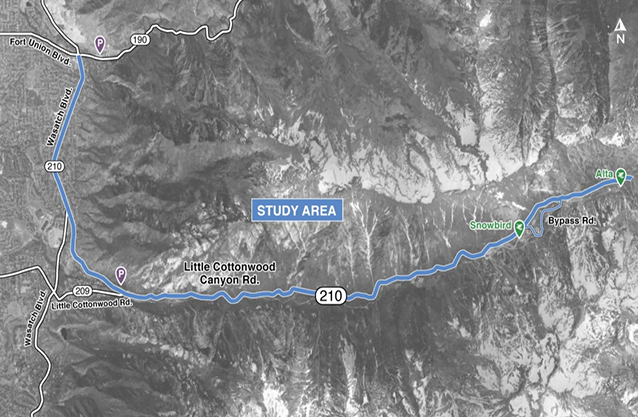
What Is Life Cycle Cost Analysis (LCCA)?
LCCA is a method used by transportation agencies to evaluate the total cost of infrastructure projects over their full operational lifespan—typically 30 years or more. The method allows policymakers to weigh short-term expenses against long-term financial sustainability.It includes:
- Capital construction costs
- Ongoing operations and maintenance (O&M)
- Discounting future costs to reflect inflation and the time value of money
- Key assumption risk assessment and scenario analysis
Key Alternatives Compared by UDOT
| Scenario | 30-Year Life Cycle Cost |
|---|---|
| Enhanced Bus Service | $1.33 billion |
| Enhanced Bus w/ Shoulder Lane | $1.33 billion |
| Gondola A (Base of Canyon) | $1.27 billion |
| Gondola B (La Caille) | $904 million |
| Cog Rail (La Caille) | $1.42 billion |
Source: UDOT Revised LCCA, Feb. 2023
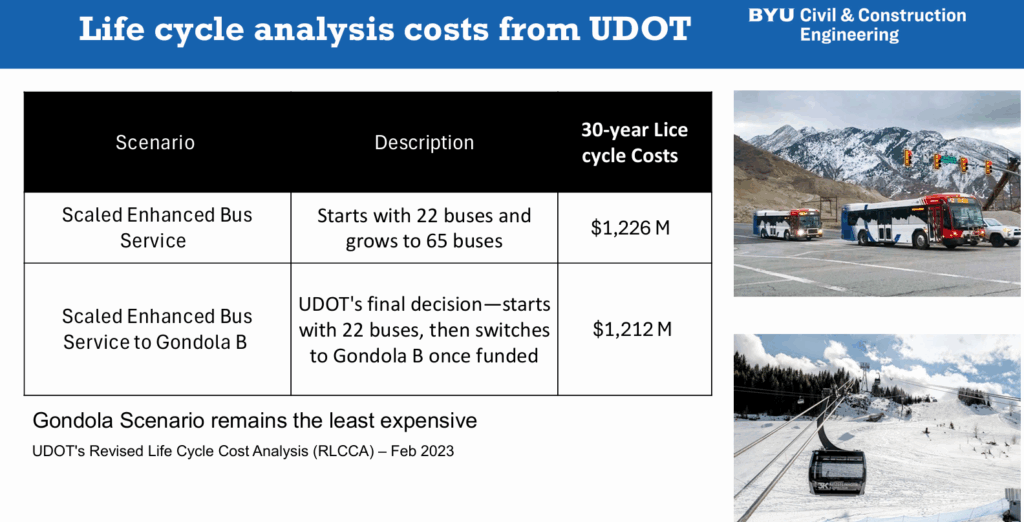
UDOT selected Gondola B as its preferred alternative, citing its lower long-term cost, despite a higher upfront price tag.
What Did BYU’s Independent Analysis Find?
Using the same cost assumptions as UDOT but applying best practices in economic modeling, the independent study found:
1. UDOT’s Discount Rate Assumptions Were Flawed
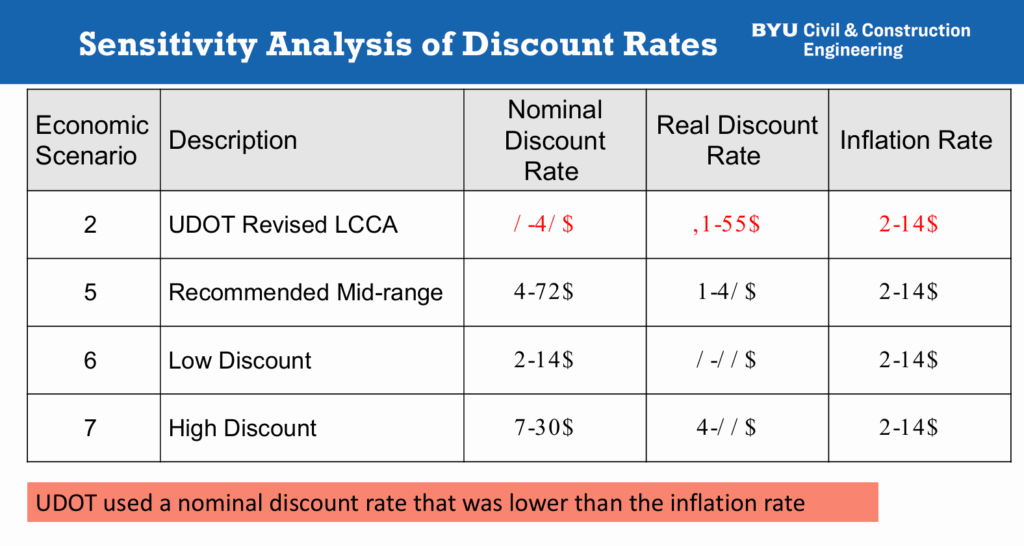
UDOT used a discount rate that was arguably too low, which may have inflated the perceived cost-effectiveness of the gondola. Researchers tested multiple scenarios using rates aligned with federal guidance (e.g., OMB Circular A-94). It is unclear why UDOT used a negative discount rate that is not in conformity with the rate recommended by the Utah Office of Management and Budget.
2. Shorter Time Frame Used By UDOT May Skew Results
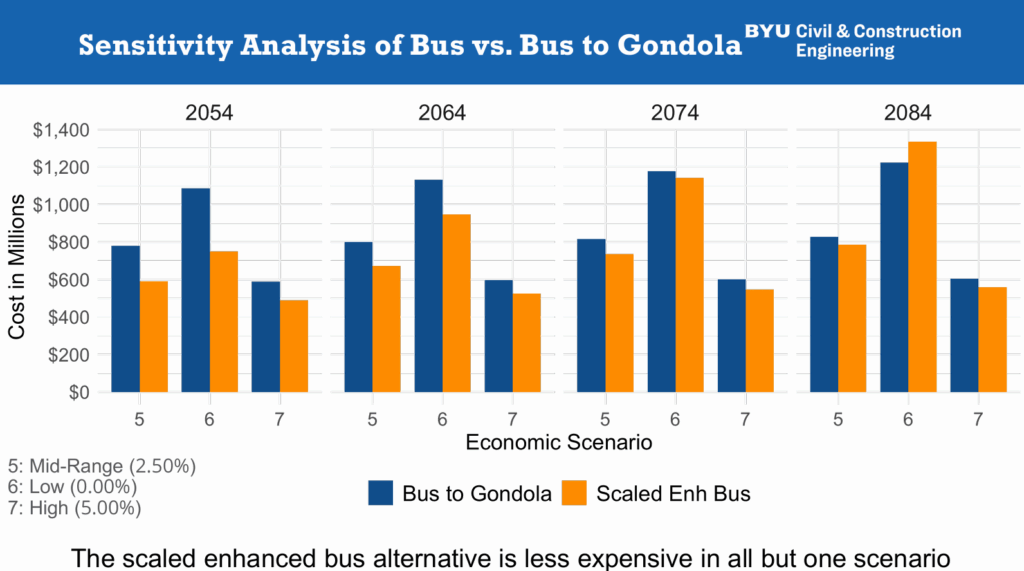
UDOT’s 30-year analysis period doesn’t cover the full expected lifespan of the gondola. When longer periods (40, 50, and 60 years) were modeled, cost differences between options became less dramatic.
3. Scaled Bus Service May Be Cheaper
The researchers evaluated an implementation path starting with enhanced bus service and eventually switching to the gondola (UDOT’s actual plan). Their findings show scaled enhanced bus service alone is the least expensive option across most scenarios.
Risk Factors Underrepresented
The study also raises concerns about the cost risks associated with the gondola:
- The gondola would be the longest gondola ever to be built in the world, raising concerns about cost overruns and operational challenges which have never been seen in other gondola projects.
- Legal disputes and environmental lawsuits have already delayed the project, potentially adding to cost overruns.
- UDOT applied a uniform 20% contingency to all alternatives, potentially underestimating risks unique to large-scale infrastructure like the LCC gondola.
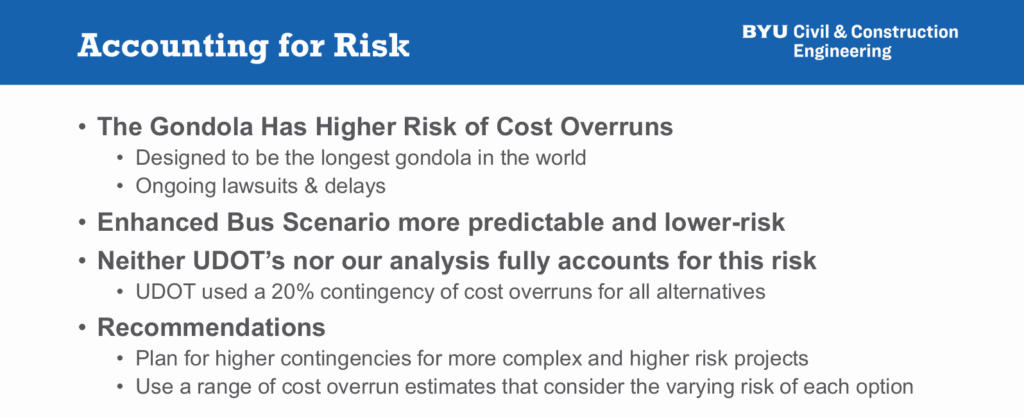
BYU Recommendation: Cost contingencies should reflect the complexity and uncertainty of each option—not a one-size-fits-all estimate.
Bottom Line: Is the Gondola Cheaper?
Not necessarily. While UDOT’s original analysis found Gondola B to be the cheapest, the independent BYU study shows that:
- Under more realistic economic assumptions, the cost advantage of Gondola B shrinks significantly.
- Enhanced bus service ALONE (without a gondola) emerges as the lower-cost, lower-risk option in most long-term scenarios.
Conclusion
This LCCA study doesn’t necessarily argue for or against the gondola. Instead, it sheds insights into the need for greater scrutiny and transparency in how such major public investments of taxpayer funds are evaluated. However, based on the many issues the BYU analysis raised, we cannot help but question why UDOT did not follow best practices for LCCA in its analysis of LCC transportation alternatives, particularly with respect to the discount rate used, the shorter timeline used, the lack of key assumption risk assessment and scenario analysis.
Sources & Further Reading
- UDOT Little Cottonwood Canyon Project: https://littlecottonwoodeis.udot.utah.gov
- UDOT Revised LCCA Report (Feb 2023)
- Independent LCCA Study by BYU (May 2025): LCCA of LCC May 9
