
UDOT Record of Decision and EIS
UDOT Record of Decision (ROD)
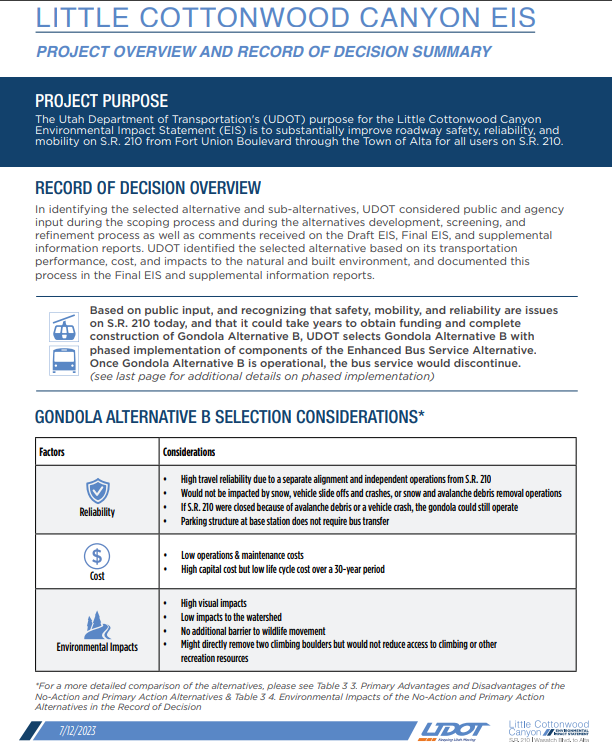
The Utah Department of Transportation (UDOT) released its Record of Decision (ROD) on July 12, 2023, concluding a multi-year Environmental Impact Statement (EIS) process to address congestion in Little Cottonwood Canyon along State Route 210. After evaluating numerous alternatives and considering over 50,000 public comments—the most ever received for a UDOT environmental study—the agency selected Gondola Alternative B, paired with a phased implementation of Enhanced Bus Service components, as the preferred solution.
The ROD outlines a three-phase approach, with the gondola chosen in Phase three. UDOT justified its gondola decision saying it has high travel reliability, as it operates independently of road conditions like weather, crashes, or slow traffic, despite its notable visual impact.
Three Phases of UDOT's ROD
- Phase 1: Set to launch in fall 2025 (did not happen due to lawsuits) with funding from Senate Bill 2 (2023), featuring enhanced bus service scaled to demand, a mobility hub at the Gravel Pit, resort bus stops at Snowbird and Alta, tolling, and winter roadside parking restrictions—all without widening the canyon roadway.
- Phase 2: Contingent on future funding, includes improvements to Wasatch Boulevard, snow sheds, and trailhead parking enhancements
-
Phase 3: Construction of the 8-mile long gondola and a 2,500-space parking base station at the canyon’s mouth, also dependent on securing additional funds.
Key Problems With UDOT's ROD
- UDOT failed to comply with the National Environmental Policy Act (NEPA) by not conducting a thorough and objective environmental review. UDOT essentially predetermined the gondola outcome, skewing the EIS by only seriously considering car-dependent alternatives and ignoring broader congestion impacts, such as those on adjacent wilderness areas like Twin Peaks and Lone Peak.
- The EIS neglected to adequately assess impacts on the canyon’s watershed—a critical drinking water source for over a million people—despite repeated requests for such analysis. They claim UDOT treated the canyon as a generic roadway rather than a protected ecological zone, overlooking risks to water quality from construction debris and increased year-round traffic spurred by the gondola.
-
UDOT’s focus on traffic congestion ignored cheaper, less invasive alternatives like enhanced busing and parking management, which could meet the 30% traffic reduction goal without the gondola’s environmental footprint.
- Despite 60-80% of public comments and polls opposing the gondola, UDOT proceeded with it, leading to claims of dismissing community input. Canyon Guard and others contend the EIS prioritized ski resort interests over equitable access for diverse canyon users, violating transportation laws meant to protect public lands.
"Little Cottonwood actually provides water to a million people. It’s a very precious resource. We want to make sure that is adequately addressed." ~Deputy Salt Lake Public Utilities Director, Jesse Stewart
(EIS) Environmental Impact Survey
The Utah Department of Transportation (UDOT) conducted an Environmental Impact Statement (EIS) for the Little Cottonwood Canyon project, culminating in the Final EIS released in August 2022 and the Record of Decision (ROD) on July 12, 2023. The full EIS documentation, including the Final EIS and supplemental reports, is available on the project website (littlecottonwoodeis.udot.utah.gov).
Key Highlights
-
Selection of Gondola Alternative B with Phased Implementation: The EIS identified Gondola Alternative B, paired with phased components of Enhanced Bus Service, as the preferred solution to address congestion, safety, and reliability on State Route 210. UDOT chose the gondola for its ability to operate independently of road conditions, offering high travel reliability.
-
Phased Approach to Implementation: The EIS outlines a three-phase plan: Phase 1 (starting fall 2025) includes enhanced bus service, tolling, and parking restrictions; Phase 2 involves Wasatch Boulevard improvements and snow sheds; and Phase 3, contingent on funding, constructs the gondola and a 2,500-space parking base.
- Environmental Benefits Emphasized: The gondola was noted for low impacts to the watershed, wildlife movement, and climbing boulders, alongside reduced vehicle emissions from shifting to transit. The EIS claims it supports air quality improvements and watershed protection compared to road-based alternatives.
Key Problems & Criticisms
- Inadequate Environmental Review (NEPA Violation): Lawsuits allege UDOT violated the National Environmental Policy Act (NEPA) by predetermining the gondola outcome and failing to rigorously evaluate alternatives like enhanced busing alone. Critics argue the EIS lacked a comprehensive analysis of ecological impacts.
-
Watershed Impact Oversight: The EIS did not sufficiently assess risks to the canyon’s watershed, which supplies drinking water to over a million people. Construction debris and increased visitation could release contaminants like heavy metals, a concern UDOT allegedly downplayed despite public requests for deeper study
- Visual and Ecological Footprint: The gondola’s 22 towers (averaging 240 feet tall) as a permanent visual blight and ecological disruption, affecting trailheads, climbing routes, and wildlife habitats (e.g., golden eagle nests).
- Narrow Scope and Regional Neglect: The EIS study area was too limited, ignoring broader congestion issues (e.g., Twin Peaks and Lone Peak wilderness areas) and cumulative effects under climate change.
