
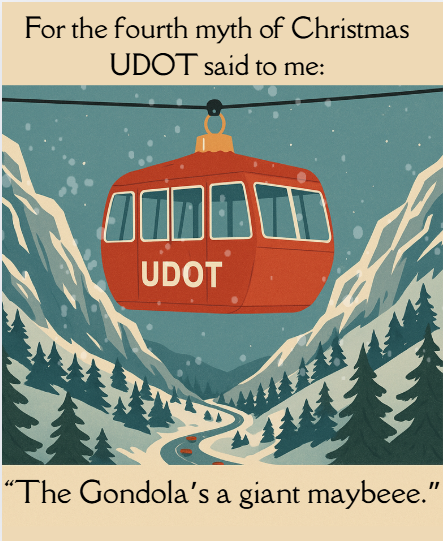
Gondola B is the selected long-term alternative, with buses and sheds as stepping stones, not as a test that can cancel the gondola.
___________________________________________________________________________________________________________________________________________________
You’ve probably heard some version of this promise from UDOT, politicians and other stakeholders regarding the proposed Gondola B solution for Little Cottonwood Canyon:
“We’ll start with more frequent buses and avalanche sheds. We’ll only build the gondola if those don’t work.”
It’s a comforting narrative that works to appease the largely anti-gondola tax-paying public. A “phased approach” makes UDOT’s Record of Decision and choice for a phased Gondola B approach sound cautious, well thought out, and flexible: try low-impact, low cost changes first, then decide later whether building the world’s longest gondola at a rising cost of $1Bn+ is really necessary to alleviate traffic congestion.
But that’s not what UDOT actually decided.
What UDOT’s Record of Decision really means
In 2022, UDOT’s Final Environmental Impact Statement (FEIS) identified Gondola Alternative B as the “preferred alternative” for Little Cottonwood Canyon. In 2023, UDOT in its Record of Decision (ROD) selected “Gondola Alternative B, with phased implementation of Enhanced Bus Service components.” (Little Cottonwood EIS+1)
Those “phases” look like this:
-
Phase 1: more and better buses, mobility hubs at the Gravel Pit and 9400 S, tolling, winter roadside parking restrictions.
-
Phase 2: Wasatch Boulevard widening (many forget this unpopular detail) and improvements, snow sheds, trailhead parking work.
-
Phase 3: build Gondola B – a base station with ~2,500 parking spaces at the mouth of the canyon and an 8-mile gondola.
The key detail is hidden in the fine print:
Implementation of Gondola Alternative B in Phase 3 is “dependent on available funding,”— not on whether Phases 1 and 2 succeed or fail.
In other words, the only trigger UDOT names for building the gondola is money. There is no clause in its ROD that says “if buses, sheds and tolls meet certain performance or congestion reduction targets, we will not build the gondola.”
No performance test, no off-ramp
Critics have pointed out that UDOT’s “phased implementation” doesn’t include:
-
Clear metrics for what “success” would look like for improved buses, tolling, or snow sheds, or
-
A requirement to pause and reconsider the gondola if those early measures reduce congestion enough.
UDOT’s Gondola B plan does not include a concrete timeline or intermediate evaluations to determine whether Phases 1 or 2 are successful at reducing traffic.
Local governments have noticed this gap too. Salt Lake County’s mayor and council, and the Central Wasatch Commission, have passed resolutions and submitted comments supporting a “common-sense solutions” approach that would invest in buses, tolling, and operational fixes instead of committing to a gondola upfront.
Those resolutions are important politically, but they are not legally binding on UDOT or the Legislature.
On top of that, UDOT’s own FAQ states that once the gondola is operational in Phase 3, bus service in Little Cottonwood Canyon would be discontinued.
That’s the opposite of “we’ll stick with buses and tolls if they work.”
Meanwhile, the gondola money pipeline is already built
Behind the scenes, the Legislature has created a dedicated Cottonwood Canyons Transportation Investment Fund (CCTIF) inside the state’s transportation funding system. State law explicitly allows money in this fund to be spent on “public transit or transportation projects in the Cottonwood Canyons of Salt Lake County.”
From 2017 through FY25 the Legislature has already appropriated nearly $400 million for Cottonwood Canyons transportation improvements, much of it flowing through this fund.
That money can legally be spent on bus improvements, avalanche sheds, road work…or a gondola. The fund doesn’t guarantee a gondola will be built—but it does mean a dedicated funding runway is quietly being prepared.
And who’s to say UDOT won’t spend less on busses and other solutions than it should to ensure peak performance in favor of using the monies for the gondola?
Why this matters
Put all of this together, and UDOT’s Myth #4 falls apart:
-
UDOT has already selected Gondola B as the long-term solution.
-
Phases 1 and 2 (buses, tolling, snow sheds) are not a binding “solution” that can cancel the gondola; Phase 3 moves forward when funding is available.
-
Once the gondola opens, UDOT’s own plan is to shut down canyon bus service, not to keep it if it works.
-
The CCTIF is already stockpiling hundreds of millions of dollars that can be used on Cottonwood Canyons projects—including the gondola.
So yes, Utah can and should improve buses, tolling, and avalanche safety right now.
But unless the ROD is changed, those improvements do not protect the canyon from eventually getting a permanent, industrial-scale gondola on top of them.
That’s why public engagement still matters: to demand a truly flexible, bus-first plan with clear performance benchmarks—and to insist that our dedicated canyon funds be used for solutions that actually solve traffic without permanently scarring Little Cottonwood.
