
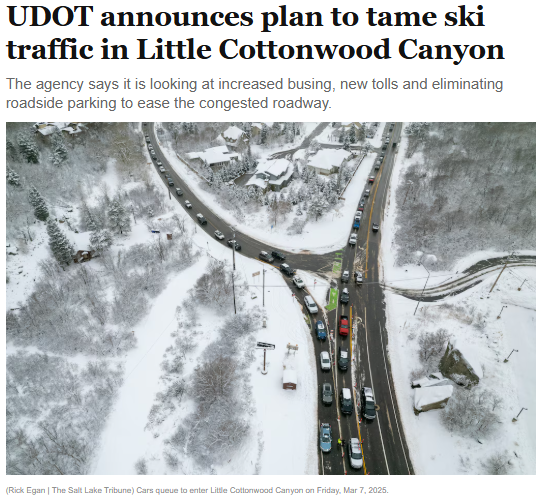
Many are elated over UDOT’s recent about-face decision to begin Phase 1 congestion improvements in Little Cottonwood Canyon (LCC) after claiming, for nearly two years, that lawsuits prohibited this very action. We understand the excitement. And while we appreciate UDOT’s long history of providing Utah residents an expansive transportation system, our concerns are not primarily about what UDOT announced—it’s about what UDOT’s announcement omits.
UDOT said plans include restoring more frequent ski bus service in LCC to 10-20-minute intervals, building a mobility hub at the mouth of Big Cottonwood Canyon, and adding sheltered bus stops at Alta and Snowbird. But UDOT did not commit to any specific ski bus service at any specific time in the future. Here’s why we are skeptical about this announcement:
- UDOT states it will restore service to “10 to 20-minute peak intervals” but gives no date when that service level will be provided or specifics about intervals.
- If UDOT provides only 20-minute intervals, service will remain worse than peak service in 2021–2022, when ski buses ran every 15 minutes.
- UDOT has the funding, the legislative mandate, and the availability of parking to return to 2021–2022 levels immediately—so why won’t UDOT commit to 15-minute intervals in 2026?
Before 2022, ski buses ran in LCC every 15 minutes during peak times on two routes. Then in fall 2022, UTA and UDOT reduced ski bus service by an estimated 75%. For 2025–2026, service was partially restored but remains about 50% below what it was before 2022. So what then does UDOT’s “10–20 minutes” announcement actually mean in practice? Will riders see 10-minute, 15-minute, or 20-minute intervals—and on which routes? UDOT’s only official commitment to restoring ski bus service levels is a vague promise of “improved bus service and infrastructure over the next two years.”
That vagueness would be easier to accept if Phase 1 were new. It isn’t. UDOT has had years—and tens of millions in taxpayer funding dedicated to canyon transit improvements—to develop a concrete Phase 1 implementation plan.
UDOT also failed to provide a firm timeline. Officials said they “hope” for incremental improvements, while the project manager suggested 10-minute service may still be years away—possibly not until the end of the decade. This timeline drift is especially hard to square with UDOT’s own prior commitments. Its 2023 Record of Decision stated that the mobility hub would be in place by the 2025/2026 ski season. If that was the plan then, what changed? Did UDOT do no meaningful planning while it slow-played Phase 1 implementation due to lawsuits?
UDOT’s parking explanation also doesn’t align with past reality, either. In the Salt Lake Tribune, UDOT was quoted saying it intends to increase bus service “as soon as it finds sufficient parking.” But there was sufficient parking in 2022, and it’s unclear what has materially changed since. If parking is now the limiting factor, UDOT should explain exactly why and what specific conditions must be met before bus service is restored.
Finally, what are UDOT’s plan metrics? After years of planning and funding, UDOT should be able to point to some baseline data and performance measures to judge whether increased busing is working—ridership, travel time reliability, canyon wait times, safety outcomes, and congestion impacts.
Which brings us to our basic question: what is stopping UDOT from adding more ski buses now, or next winter? The funding exists. The operational precedent exists. If UDOT can promise shelters and mobility hubs over the “next two years,” it can restore meaningful ski bus frequency and reliability immediately.
So here we are in 2026 being asked to celebrate “hope” for “incremental improvements,” without firm commitments on service levels, schedules, or measurable outcomes. That’s not a plan—it’s a press release.
If UDOT wants credit for “improvement,” it must define improvement—by specific routes, minutes, capacity, metrics, and dates—and then deliver it.
