
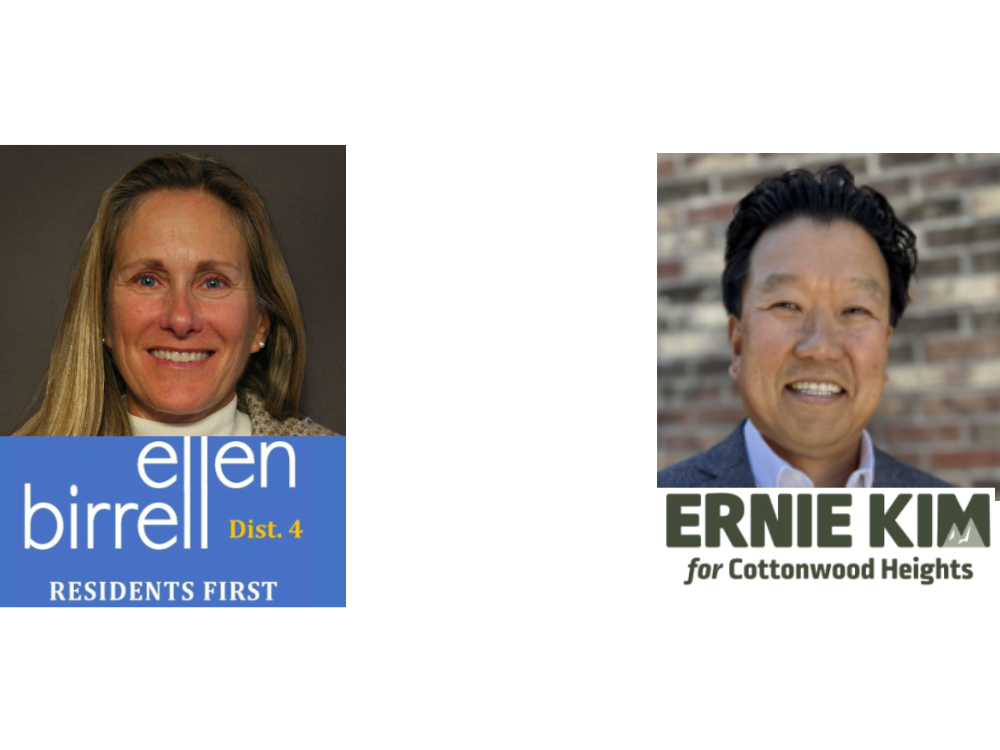
Candidates: Ellen Birrell (incumbent) and Ernie Kim
As Cottonwood Heights voters head into the November 2025 municipal election, Council District 4 candidates Ellen Birrell and Ernie Kim present a united front against overreach from state projects while championing local livability. Both strongly oppose UDOT’s proposed 8-mile gondola, viewing it as an unnecessary taxpayer burden that fails to address real traffic woes. Their visions for Wasatch Boulevard emphasize transforming it from a high-speed commuter route into a safe, scenic gateway to the canyons, with calls for traffic calming, protected paths, and 35 MPH limits over lane expansions.
On key city challenges, they converge on traffic safety, housing affordability, and environmental stewardship—Birrell tying these to pollution reduction, water conservation via xeriscaping, and community gardens, while Kim focuses on data-driven advocacy, resident-led zoning, and preserving open spaces against overdevelopment.
Their responses highlight a shared commitment to community-centric action: leveraging city authority to rein in UDOT, fostering inclusive planning, and prioritizing suburban character amid Utah’s explosive growth.
This alignment signals potential for collaborative governance, but subtle differences emerge in tactics—Birrell’s emphasis on immediate redesigns and fiscal “political will,” versus Kim’s structured partnerships and proactive studies—offering voters clear choices on execution.
Please note that we do not contribute to political campaigns nor do any political candidates or campaigns endorse or affiliate with our work.
Question 1: The Utah Department of Transportation (UDOT) has proposed constructing an 8-mile gondola, funded by taxpayer dollars, to improve accessibility to the ski resorts and to accommodate a projected 60% population growth. The Wasatch Front Regional Council estimates the cost of building and operating the gondola would be $1.4 billion. Are you (choose one):
Ellen Birrell: Strongly against the plan
Ernie Kim: Strongly against the plan
Question 2: What are your thoughts for the future of Wasatch Blvd, the challenges it faces, and UDOT’s plans for this artery? What steps will you take to address these challenges and UDOT’s plans?
Ellen Birrell: The best future for Wasatch Blvd SR 190 & 210 is for the State to see this corridor as the gateway to Big and Little Cottonwood Canyons and protect it like they do within canyon portions against motorist speed and billboards. Strava reports show heavy bicycling usage. Two recent pedestrian deaths point up: “recreation mecca not a commuter highway.”
SR 210 should not be expanded, instead immediately redesigned to 35 mph maximum speed with treed-medians, daylighted intersections, multi-use path on both sides.
I achieved removal from Cottonwood Height Wasatch Blvd master plan of “transit lane or shoulder lane may be used by private vehicles during peak times”. This restrains motor vehicles and promotes transit.
Municipalities have jurisdictional authority where city-owned roads intersect state routes. UDOT is willing for other “betterments”, too. Need is for political will of council majority to use general funds.
Ernie Kim: Wasatch Boulevard is a scenic corridor that also functions as a neighborhood artery. Its greatest challenges are high vehicle speeds, dangerous pedestrian and bike conditions, and UDOT’s focus on widening and increasing traffic capacity rather than prioritizing livability.
As a councilmember, I will:
• Advocate against road widening that encourages higher speeds and commuter traffic.
• Push for traffic calming, speed reduction, and safe design standards (protected bike lanes, safer crossings, narrower lanes).
• Partner with UDOT through data-driven advocacy and community coalitions to ensure safety and neighborhood character drive the final design.
Question 3: What do you think are the top 3 issues/problems currently facing Cottonwood Heights?
Ellen Birrell:
1. Gondola/parking garage/SR 210 expansion do nothing to relieve bottleneck or pollution. Need to create visual friction through treed-medians & daylighting intersections on all state routes & city-owned roadways. This slows motorist speed reducing severity of crashes while beautifying, cooling summer temps, filtering air, reducing noise pollution.
2. Housing. Short & long-term planning to ensure that residents can continue to afford to live in their homes; also smaller, less expensive housing for working people and seniors who cannot maintain large homes.
3. Water. Singular fastest rising monthly bill incurred by residents relates to water consumption. By converting city-owned landscaping to xeriscaping and/or food farms utilizing a citizen committee serves to educate & inspire homeowners and could assist individual property owners who are experiencing blighted yards and trees, Community Gardens would bring assistance to those in financial need, as well as unify and beautify our city.
Ernie Kim:
1. Traffic and safety on Wasatch Boulevard and canyon access roads – balancing commuter demand with local safety.
2. Housing affordability and smart development – ensuring growth does not compromise our city’s character or infrastructure.
3. Preserving open space and community identity – protecting trails, recreation access, and the feel of Cottonwood Heights against overdevelopment.
Question 4: What do you think the CWH Mayor and Council should do more of, less of, or differently to address each of these 3 issues?
Ellen Birrell:
1. Gondola/parking garage/SR 210 expansion do nothing to relieve bottleneck or pollution. Need to create visual friction through treed-medians & daylighting intersections on all state routes & city-owned roadways. This slows motorist speed reducing severity of crashes while beautifying, cooling summer temps, filtering air, reducing noise pollution.
2. Housing. Short & long-term planning to ensure that residents can continue to afford to live in their homes; also smaller, less expensive housing for working people and seniors who cannot maintain large homes.
3. Water. Singular fastest rising monthly bill incurred by residents relates to water consumption. By converting city-owned landscaping to xeriscaping and/or food farms utilizing a citizen committee serves to educate & inspire homeowners and could assist individual property owners who are experiencing blighted yards and trees, Community Gardens would bring assistance to those in financial need, as well as unify and beautify our city.
Ernie Kim:
• On traffic and safety: Do more to challenge UDOT when state priorities clash with local safety. Invest in traffic studies, collect crash data, and proactively propose community-led solutions.
• On housing/development: Do more to involve residents early in planning decisions. Be less reactive to developer proposals and more proactive in setting community-driven zoning guidelines.
• On open space: Do more to protect recreation access and scenic corridors. Be less accommodating of large-scale projects that reduce livability, and more aggressive in pursuing grants or partnerships that preserve trails, parks, and green space.
